Quetelet, Adolphe
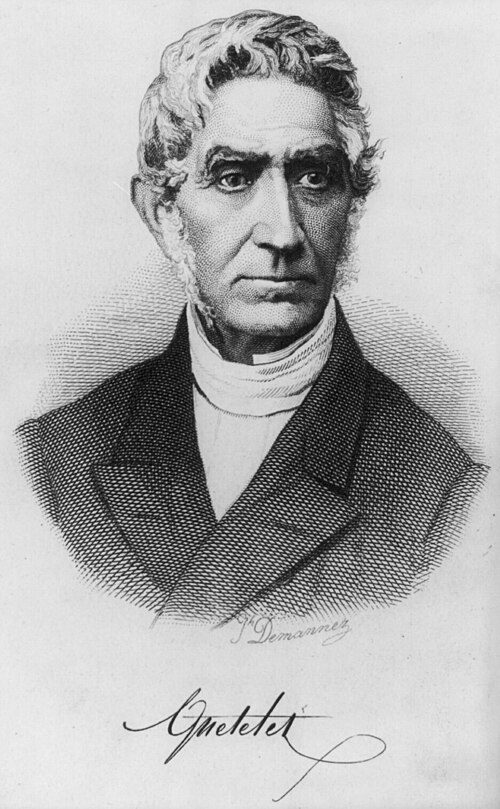
Bio: (1796–1874) Belgian mathematician, statistician, astronomer, and sociologist. Adolphe Quetelet received his doctorate from the University of Ghent. He lectured at the Brussels Athenaeum and at a military college. He is known for developing statistical methods and probability theory and for applying them in the analysis of demographic and criminological data.
Adolphe Quetelet argued that society can be studied objectively, much like the natural sciences, by identifying patterns and regularities through statistical methods. He believed that social phenomena—such as births, deaths, marriages, and even crime—follow consistent “laws” that can be revealed through systematic data analysis. Central to his approach was the use of the bell curve, which led him to develop the concept of l’homme moyen (“the average man”). This figure represents the typical characteristics of a population, with individual people understood as imperfect variations around this average.
For Quetelet, the presence of a bell-shaped distribution indicated an underlying connection among individuals within a population. By constructing an “average man” for different populations, he enabled comparisons between them, assuming each population was relatively homogeneous. His work was especially influential in demography, where he systematically presented complete statistical distributions—such as age-specific rates of vital events—rather than relying on isolated figures. This method helped replace subjective judgments based on anecdote or prejudice with empirical evidence, which is why Quetelet is considered a founding figure in modern empirical sociology.
He was particularly struck by the stability of social statistics over time. Patterns in vital events remained remarkably consistent across years, suggesting a form of social order or regularity. Only major disruptions, like revolutions, could temporarily disturb these patterns. This raised questions about determinism and individual free will. Quetelet addressed this by distinguishing between causes constantes (constant causes), which produce stable patterns at the societal level, and causes accidentelles (accidental causes), which account for individual variation and change. In this way, he argued that while society exhibits regularity at the macro level, individuals still exercise agency, interacting with external influences and contributing to social change.
Main works
The Propensity to Crime (1831);
A Treatise On Man and the Development of his Faculties: An Essay on Social Physics (1835);
Du système social et des lois qui le régissent (1848);
Anthropometry: the Measurement of the different Faculties of Man (1871).