Hunter, Floyd
Bio: (1912–1992) American sociologist. Floyd Hunter received his master’s degree in social service administration from the University of Chicago and P.Hd. in sociology from the University of North Carolina. He taught at several universities, most notably at the University of North Carolina.
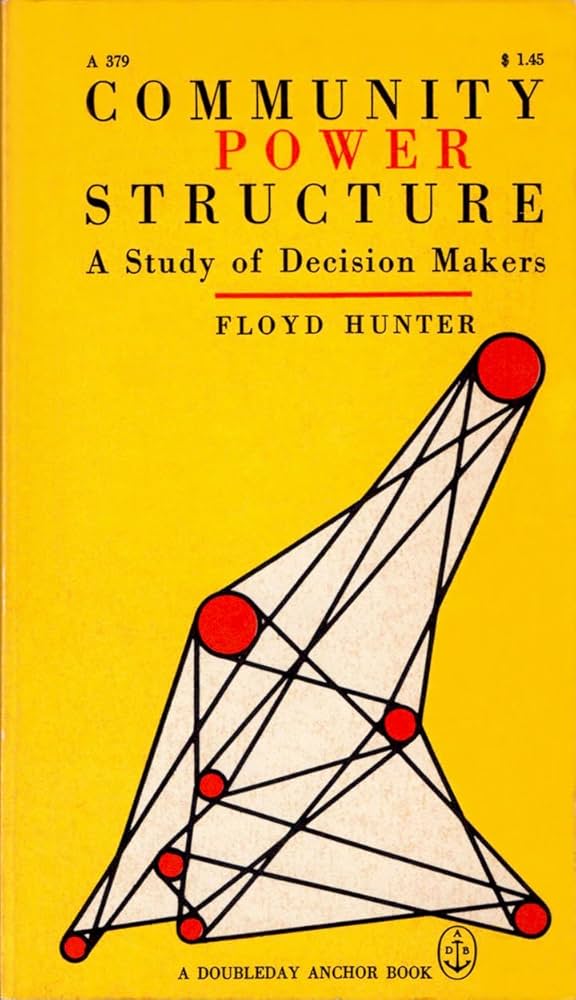
Floyd Hunter is best known for the empirical research he conducted for his dissertation, later published as Community Power Structure: A Study of Decision Makers (1953). The study examined patterns of community leadership and decision-making in Atlanta. Hunter introduced the term “power structure” to describe the enduring relationships through which major community policies are shaped and decided.
His principal conclusion was that political reality diverged sharply from the democratic ideal of representative government. Instead, policymaking tended to revolve around networks connected to the city’s leading business figures. To identify these leaders, Hunter consulted informed insiders, compiling and refining a list of forty key individuals—ten from each of four major sectors of community life. He then applied sociometric methods to map patterns of interaction among them. In addition, he analyzed specific policy issues and conducted a separate study of leadership within Atlanta’s Black community, examining its relationship to the city’s white leadership.
Hunter’s aim was not simply to determine how many individuals held power, but to explore how different sectors were interconnected and how these relationships shaped community policy. He was particularly interested in how business-centered leadership managed social change by controlling the policy agenda. Atlanta’s business elite, largely insulated from the everyday struggles of ordinary citizens—especially the poor—formed a relatively cohesive and closed group. Through their control of economic resources, prominent civic roles, and informal channels of communication that facilitated consensus, they exercised significant influence over the direction of the community.
Fields of research
Actors Civil Society Community Corporations Economy Elites Leaders Power, PoliticalMain works
Community Power Structure: A Study of Decision Makers (1953);
Top Leadership, U.S.A. (1959);
The Big Rich and the Little Rich (1965);
Community Power Succession: Atlanta’s Policy-Makers Revisited (1980).